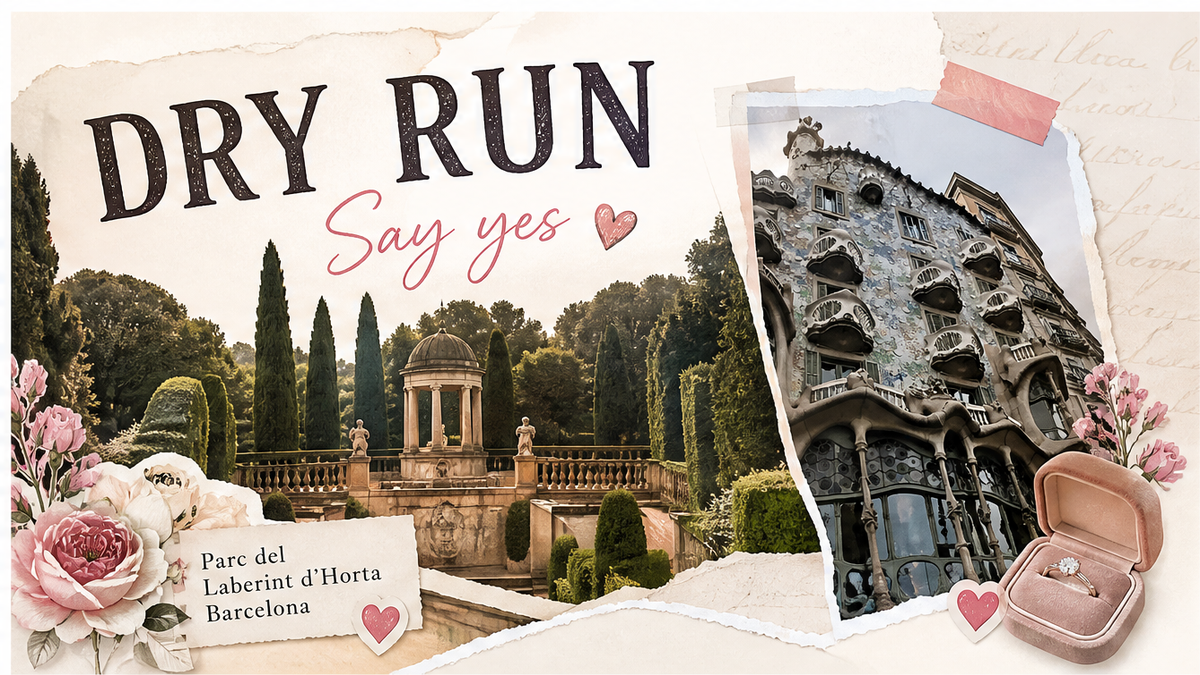
Scouting a Barcelona pin once in daylight is not the same as running the night. A dry-run is a short, boring walk that answers the only questions that matter: Can you reach the pocket on time? Where does the photographer hold? How long is the abort? This checklist treats rehearsal like a stage call – same clock, same route, no romantic performance.
Rehearse the minutes, not the speech. If the walk and the cues fail in daylight, they will not magically work at golden hour.
Decide what the dry-run must prove
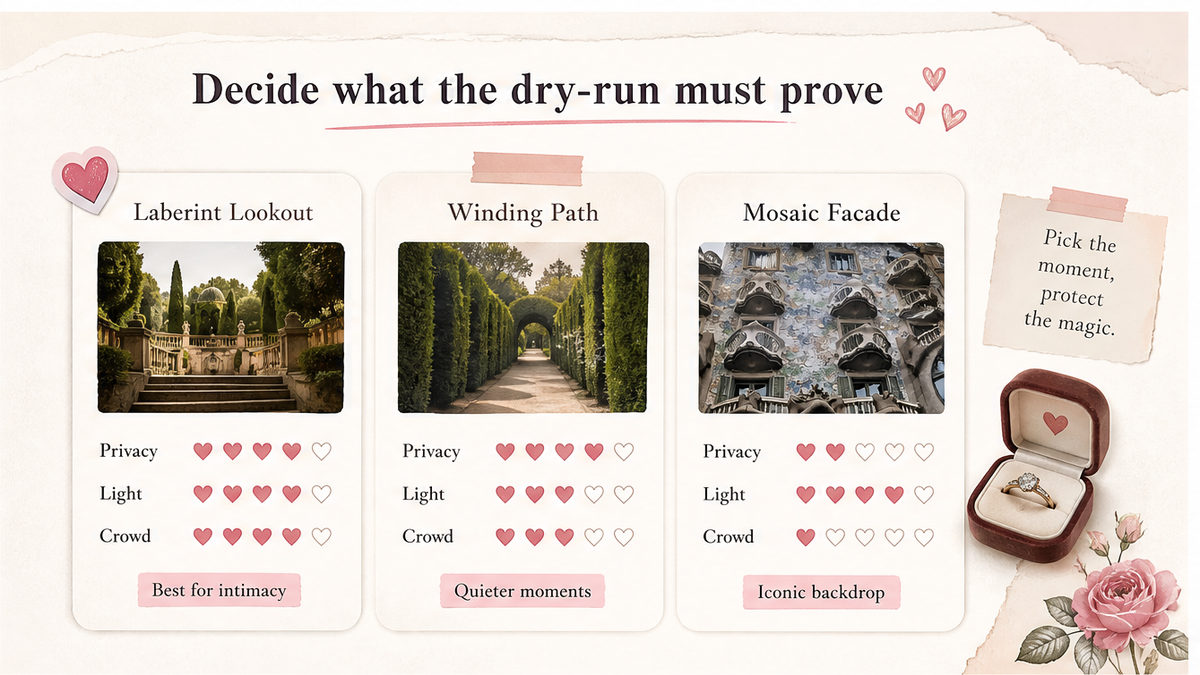
Write three proof points before you leave the hotel. If a walk does not test them, it is tourism, not rehearsal.
- Clock proof: leave at the same minute you will leave on proposal day, or reverse-engineer from the pin time.
- Pocket proof: stand in the exact ask corner and confirm sightlines, foot traffic, and where your partner will face.
- Abort proof: walk the backup lane and note how many minutes it eats if the pin is crowded or blocked.
Do not rehearse the kneel, the speech, or a fake champagne pop in public. You only need logistics certainty.
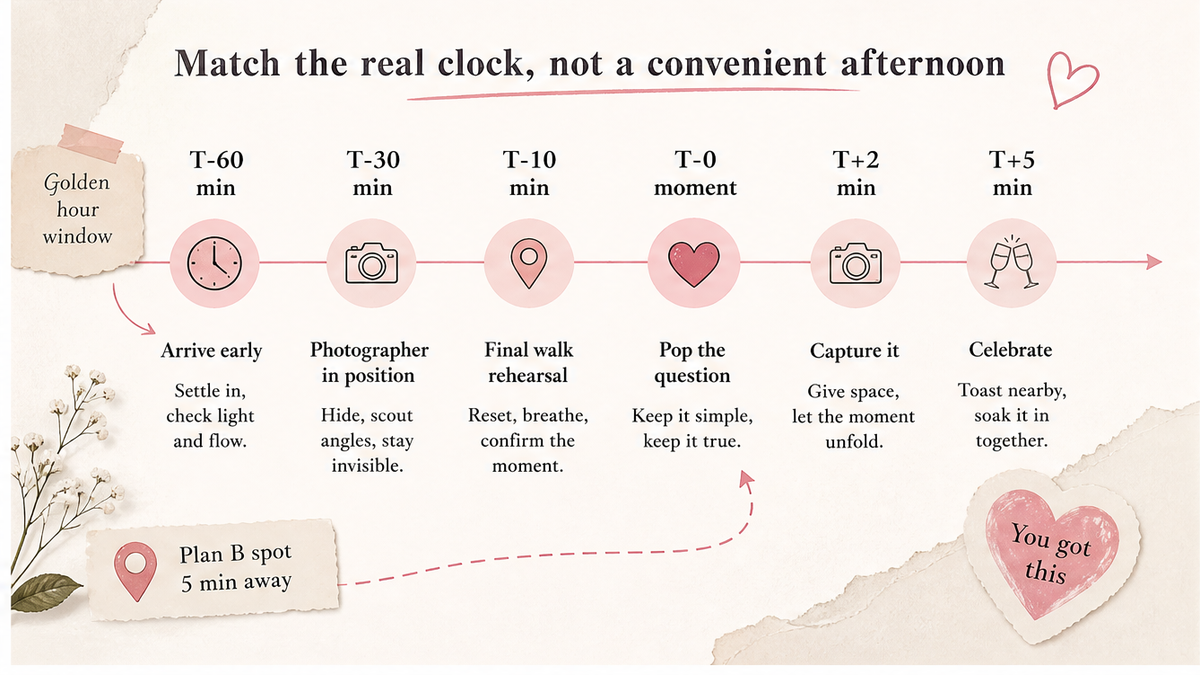
Match the real clock, not a convenient afternoon
| Rehearsal choice | Best when | Main risk |
|---|---|---|
| Same clock as proposal day | You need truthful crowd and light behavior | Harder to hide from your partner; may need a helper cover story |
| Same weekday, earlier slot | Partner is with you and you cannot disappear at pin time | Crowds and light will differ; treat findings as estimates |
| Helper-only dry-run | Photographer or planner can walk without you | You miss personal timing feel; demand photos and minute marks back |
| Split rehearsal (route then pin) | You already know the pocket from a scout day | You skip the joined timeline and underestimate transfer friction |
Barcelona changes by hour. A quiet Mirador at 11:00 can be a tour funnel at 19:30. Prefer the real clock whenever cover allows.
Run the walk like a cue sheet
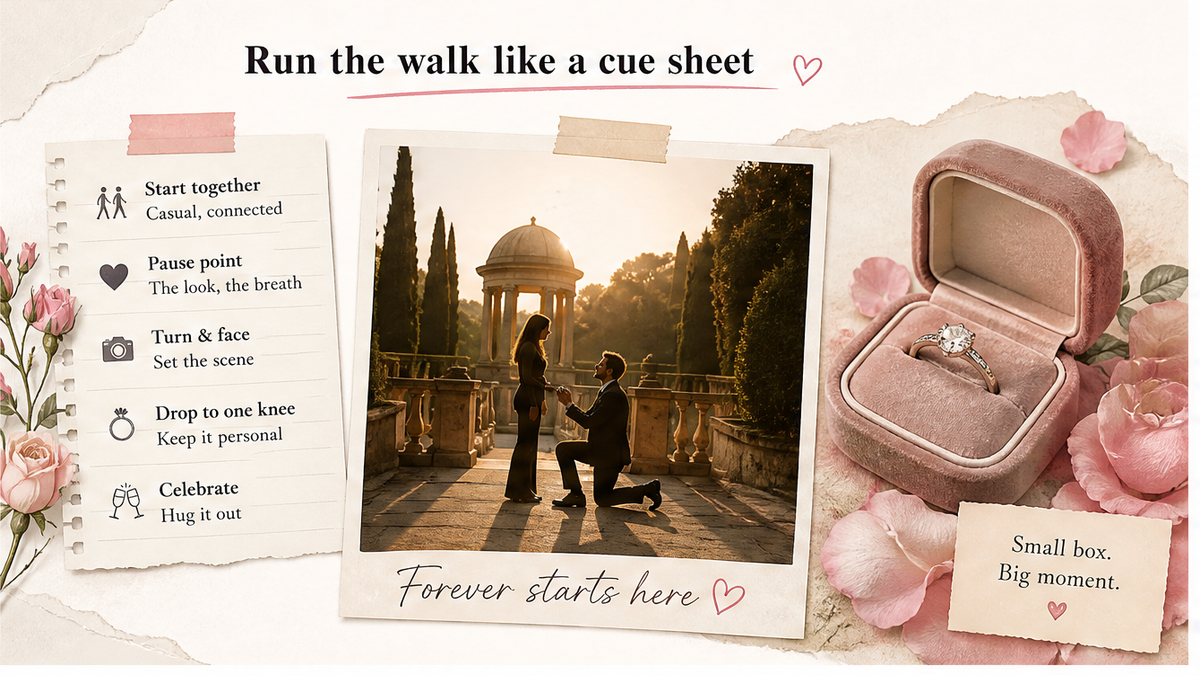
Carry a one-screen cue sheet. Fill times as you walk; do not trust memory later.
- Leave mark: hotel door or taxi pickup – start the timer.
- Transfer mark: note traffic, elevator waits, metro swaps, or walking hills that steal minutes.
- Hold mark: photographer or friend meet point; confirm it is invisible from the approach your partner will take.
- Pin mark: arrive, claim the pocket for 60 quiet seconds, then leave before you attract attention.
- Abort mark: walk Plan B and record total minutes from “pin fails” to “standing in backup.”
- Vendor mark: if dinner, florist, or musician depends on a READY text, time how long that handoff needs after the ask.
Send the filled sheet to every helper the same night. One shared clock beats three optimistic guesses.
Keep the surprise intact during rehearsal
A dry-run that spoils the night is a failed dry-run.
- Cover story: “work call,” “gym,” or a short errand – never “I need to check a viewpoint.”
- No ring on the walk: leave jewelry and props in the room safe; rehearsal is for paths and holds.
- No public staging: do not plant flowers, mark chalk, or tip staff “for tomorrow’s proposal” in earshot of locals who chat.
- Phone hygiene: delete obvious map screenshots from shared albums; keep the cue sheet in a private note.
- Partner-present variant: if you must walk together, rehearse only the dinner approach or a fake “sunset stroll” that ends before the true pocket.
What to change after the walk
Update the live plan the same evening while numbers are honest.
- Leave earlier: if transfer ate more than your buffer, move pickup, not the speech.
- Move the hold: if the photographer nest is visible from the approach, pick a deeper corner or a doorway offset.
- Swap the pin: if the pocket never clears for 60 seconds at the real clock, promote Plan B now – do not hope proposal day is emptier.
- Rewrite vendor texts: shorten READY / ABORT messages so nobody invents a fourth meeting point under stress.
Your scout day chose the place. The dry-run decides whether that place still deserves the ring time.
Common failure modes
- Daylight-only scout: you know the view, not the 19:40 crowd; schedule a clock-matched walk.
- Rehearsing the speech in public: draws eyes and wastes the surprise; keep it logistics-only.
- No abort timing: you discover Plan B is a 25-minute walk when dinner is in 15; measure it.
- Helpers missing the walk: they invent their own hold; require at least one shared dry-run or annotated photos.
- Leaving clues: calendar titles, shared Maps pins labeled “proposal,” or staff tipped too loudly.
A good rehearsal is short, timed, and boring. Boring is how the real minute stays calm.
FAQ
How long should a Barcelona proposal dry-run take?
Usually 30–60 minutes: leave mark, pin pocket, abort lane, and one hold point. Stop before it becomes a second date walk.
Do I need the photographer on the rehearsal?
Ideally yes for the hold point. If not, send them pin photos, approach direction, and a named meet landmark the same day.
What if my partner is with me the whole trip?
Use a helper-only dry-run at the real clock, or rehearse only the transfer and dinner approach while saving the pocket for proposal day.
Is scout day enough without a dry-run?
Scout picks the pin. Dry-run proves the minute. In busy Barcelona hours, you usually need both.
Fact-check notes
- Crowd density, terrace access, and street closures change by season, events, and weekday; verify near your date.
- A rehearsal does not guarantee an empty pocket; it only measures likely timing and abort cost.
- This is logistics guidance for surprise planning, not a permit or security instruction for any site.
- Never block paths, climb restricted areas, or stage props that violate venue rules during a dry-run.
Related reading
Pair this with Barcelona proposal scout day checklist so the place you chose still works at the real proposal clock.
Want a planner to lock the cue sheet, holds, and abort timing? Plan My Proposal.